“True peace is not merely the absence of tension: it is the presence of justice”…Dr. Martin Luther King Jr.
Dr. Martin Luther King Jr. and Mahatma Gandhi are widely known for their peaceful demonstrations because they believed it was the most effective way to achieve social justice. However, their stance was not without its consequences which resulted in lost lives. Yet, they did not waiver, partly because of their moral convictions, and also because they believed that peaceful protests would lead to sympathetic media coverage and the influencing of public opinion.
Both Dr. Martin Luther King Jr. and Mahatma Gandhi made deliberate choices to suffer in order to expose injustice because they were committed to higher goals. However, politics are not the only areas in our lives where we may have to make difficult choices as it relates to peace.
PROTECTING YOUR PEACE
“When we have peace in our hearts and minds, we draw peace into our lives”…Iyanla Vanzant
Dr. Iyanla Vanzant is a well-known spiritual teacher, life coach and also a #1 New York Times bestselling author. She also hosted a very popular show on the OWN Network called: “Iyanla: Fix My Life” , where she helped guests confront deep-seated emotional issues, (which she is also no stranger to). During several public media appearances in January of 2026 (e.g. The Tamron Hall Show and The Breakfast Club), Vanzant spoke candidly about how she dealt with the deaths of her two daughters (Gemmia Vanzant in 2003 and Nisa Vanzant in 2023). As it relates to her youngest daughter (Nisa Vanzant) who died at the age of 48 in July 2023, she spoke candidly about why she decided not to attend her daughter’s funeral. In essence, it was in order to “protect her peace” due to the anticipated negative dynamics related to unresolved family issues and conflicts.
There was an article posted on https://www.rememberingalife.com/ by Elizabeth Lewis who is a grief and support specialist. In the article, she shared a story about being present during the last moments of her sister’s life and conflicts that she actually witnessed involving loved ones. Both due to Elizabeth’s personal and professional experience, she concluded that difficult family dynamics that occur at the end of someone’s life are due to factors such as: unresolved past family conflicts, dissimilar values and beliefs held by family members, different grieving styles and responses, differing stress responses and differing levels of coping and communication skills. In light of these common negative family dynamics, it may be time to consider walking away to find and protect your peace.
BRINGING MORE PEACE INTO YOUR LIFE
“Nothing can bring you peace but yourself”…Ralph Waldo Emerson
One of the best places to begin bringing more peace into your life is taking a journey within. This relates to discovering your inner calm which can be developed and nurtured through practices like prayer, meditation and self-love. Both Dr. King and Gandhi are great examples of individuals who were at peace as they fulfilled their life’s mission. Although the majority of us will not have transformative international life missions like Dr. King or Gandhi, cultivating inner peace can have a profound and positive impact on others.
Join me, Renna on Friday from 4am-6am for a very inspiring musical journey about various important and intriguing topics related to this article. Remember that if you miss the live program, you can always listen to the weekly program for up to 7 days on the archives at https://www.wmnf.org/events/morning-energy/.
“Leadership is a series of behaviors rather than a role for heroes”…Margaret Wheatley
THE RISE OF A NATIONAL HERO
“The two most important days in your life are the day you are born and the day you discover why.” – Mark Twain
National heroes are defined as individuals who make significant contributions to the development of society and are also admired for qualities such as: courage, selflessness, and outstanding achievements. Some well-known national heroes include: Nelson Mandela (South Africa): Imprisoned for his relentless fight against apartheid; Mahatma Gandhi (India): Led the campaign for India’s independence from the British by championing philosophies known as (1) nonviolence (Ahimsa) and (2) nonviolent resistance (Satyagraha); and Dr. Martin Luther King Jr. (USA): Leader in the Civil Rights Movement who advocated for change through nonviolence.
In the United States, Dr. Martin Luther King Jr. is one of the most recognized national leaders, and is also widely considered to be the most prominent campaigner in the struggle for civil rights in the 20th century. King’s significant contributions to society coupled with a 15-year advocacy campaign from civil rights activists, eventually led to President Ronald Reagan signing a bill into federal law in 1983 designating the third Monday in January as MLK Day.
In addition to Dr. King being a prominent campaigner for civil rights during his lifetime, his lasting legacy also consists of timeless leadership qualities which have been taught in various professional and educational settings. However, in addition to these public trainings, it is also important to remember that we all have the ability to cultivate great leadership qualities within us that can be beneficial to our lives professionally, personally, and socially.
THE VISION
“The greatest leaders mobilize others by coalescing people around a shared vision.” Ken Blanchard
When I reflect over the lives of some of the world’s greatest heroes and leaders, I often wonder how they were able to balance their passion for change with the impending dangers that they faced from their opposition. It is widely known that most people go along with the status quo instead of taking the road less traveled because it often feels safer and familiar. On the other hand, considering potential changes introduces uncertainty. Yet, despite potential danger, there are those who chose to never abandon their vision even if it might cost them their life.
There was an article published in the January 2007 edition of The Journal of The National Medical Association titled, “The leadership principles of Dr. Martin Luther King, Jr. and their relevance to surgery”. The article was collectively authored by F. Charles Brunicardi, Ronald T. Cotton, George W. Cole, and George Martinez. Not surprisingly, the number one leadership principle that was mentioned in the article was the importance of leaders having a vision based on principle – a quality that Dr. King’s was widely respected for. The second leadership principle mentioned in the article was “effective communication”, which for Dr. King, resulted in him delivering many classic speeches such as: “I Have A Dream” and “I’ve Been to the Mountaintop”.
It was on April 3, 1968, that Dr. King gave his famous “I’ve Been to the Mountaintop” speech in front of an overflowing crowd in Memphis, Tennessee. In summary, Dr. King said, “We’ve got some difficult days ahead. But it really doesn’t matter with me now because I’ve been to the mountaintop. And I don’t mind. Like anybody I would like to live a long life. Longevity has its place, but I’m not concerned about that now. I just want to do God’s will, and He’s allowed me to go up to the mountain, and I’ve looked over and I’ve seen the Promised Land. I may not get there with you, but I want you to know tonight that we as a people will get to the Promised Land. So I’m happy tonight, I’m not worried about anything, I’m not fearing any man. Mine eyes have seen the glory of the coming of the Lord”. Less than 24 hours after this very heart wrenching and prophetic speech, Dr. King was assassinated.
The choices that Dr. King made were indeed not for the faint of heart, which probably contributed to the decline in large-scale organized events following his death. However, there are some who believe that perhaps Dr. King was “born for such a time as this” (Esther 4:14).
BORN OR MADE
“Be not afraid of greatness: some are born great, some achieve greatness, and some have greatness thrust upon ’em.” – William Shakespeare
Coach Vince Lombardi is known for saying, “Leaders aren’t born, they are made. And they are made just like anything else, through hard work. And that’s the price we’ll have to pay to achieve that goal, or any goal.” However, Lombardi’s words are in contrast to Thomas Carlyle’s “Great Man Theory” which was published in the early 1800s. As part of Carlyle’s theory, it was his belief that great men are shaped by innate and almost divine qualities. But whether or not you agree with Lombardi’s or Carlyle’s perspective is perhaps a matter of principle. However, from a modern day research standpoint, there are compelling arguments for both sides.
In 2017, there was an article published in the National Library of Medicine titled: “Point/Counterpoint: Are Outstanding Leaders Born or Made?” The article explored the long-standing debate about the origin of great leadership. In support of “innate traits and genetic predispositions”, studies of twins were used as examples. However, as it relates to the posit that great leaders are “made”, examples of individuals like Walt Disney and John D. Rockefeller were used. Walt Disney, for example, was raised by a mom who was a home-maker and a father who failed at most business schemes in which he ventured. Yet, Walt Disney prevailed, and also despite some setbacks, went on to become a great pioneer in the field of animation. John D. Rockefeller, on the other hand, was abandoned by his father as a small boy and once he grew up, started establishing his wealth slowly and methodically eventually creating the largest oil refiner in the world during the turn of the 20th century.
Indeed some people are predisposed to leadership, however, it still requires work to cultivate good leadership skills. On the other hand, for those that do not have a genetic disposition to leadership, this simply means that you hold the key to developing a powerful and effective leader within.
“It does not matter how deep you fall, what matters is how high you bounce back” ~Author Unknown
QUITTER’S DAY
The second Friday in January is often referred to as “Quitter’s Day”. The term “Quitter’s Day” surfaced in 2019 as part of statistical data from the Strava fitness app that showed how a significant number of users’ activity levels begin to drop around this time. Although the exact percentages of “quitters” vary depending on the survey methodology being used, the general statistical consensus is that approximately 80% of people abandon their resolutions within the first month.
Some of the reasons that healthcare professionals have cited for people abandoning their New Year’s resolutions include: (1) setting unrealistic goals (2) lack of support and (3) trying to live up to trendy societal expectations. Consequently, given the alarming “Quitter’s Day” statistics, it is easy to question how one can begin to “bounce back” from a “Quitter’s Day” mindset in order to achieve their goals.
Beyond one’s efforts of trying to recover from abandoning their New Year’s resolutions, there are also many other areas in our lives that we may be desiring to “Bounce Back” from which requires one to focus more on having a growth mindset.
DETERMINING YOUR “WHY”
“The two most important days in your life are the day you are born and the day you find out why” by Mark Twain
According to data from Statista.com, at the top of the list for 2026 New Year’s resolutions was to exercise more. However, although priorities can shift, historically personal fitness goals have continued to be a long standing trend which is often reflected in increased gym attendance during the month of January.
Some years ago, I worked as a personal trainer and group fitness instructor. During one of my coaching meetings with my fitness director, I remember being told to always try to determine the reason “why” a client wants to get in shape. For example, are they desiring to lose weight prior to getting married, are they losing weight to improve their overall health or are they trying to lose weight to prevent certain health conditions. Since my training days, I have since learned that, “ the why” engages deeper brain systems which helps to keep a person more anchored and committed rather than simply relying on bursts of motivations that are short-lived.
GIVING YOURSELF GRACE
“The difference between a strong man and a weak one is that the former does not give up after a defeat.” – Woodrow Wilson
“A book and the sun, everything else just works out” by sapheron is licensed under CC BY-SA 2.0. (giving yourself so grace)…
“Three Feet from Gold” is a short story popularized by Napoleon Hill in his all-time classic book, “Think and Grow Rich”. The story is about a gold miner who gave up too soon even though he was just short of striking gold. The core message of the story is that people often give up too soon despite being moments away from their breakthrough.
As you set out on your personal mission to pursue your goals, it is important to accept the reality that you are likely going to face some potentially challenging moments. However, it’s also important to remember not to allow yourself to become permanently discouraged by these challenges. Rather, choose to take time to refocus and start afresh.
Join me, Renna on Friday from 4am-6am for a very inspiring musical journey about various important and intriguing topics related to this article. Remember that if you miss the live program, you can always listen to the weekly program for up to 7 days on the archives at https://www.wmnf.org/events/morning-energy/.
“You may have a fresh start any moment you choose, for this thing that we call ‘failure’ is not the falling down, but the staying down.” Mary Pickford
TEMPORAL LANDMARKS AND THE FRESH START EFFECT
“Fresh Start” by cogdogblog is licensed under CC BY 2.0.
New Year’s Day is a significant date or point in time which behavioral scientists refer to as a temporal landmark. Other examples of temporal landmarks include: (1) momentous life events (e.g. birthdays, weddings, or anniversaries), (2) social timetables (e.g. the start of a new week, month, or season) or (3) significant public events (e.g. national elections, yearly rituals or annual memorial and dedication services).
Katherine Milkman, Hengchen Dai, and Jason Riis are the behavioral scientists who are famously known for their collaborative research on the “Fresh Start Effect“. According to the trio, experiencing temporal landmarks may produce a psychological phenomenon known as the “Fresh Start Effect” which is when people become more motivated or inspired to change, pursue new goals or adopt new habits. Their work also revealed how temporal landmarks also help to create a psychological distance from past failures while simultaneously increasing optimism.
Popular changes that people typically seek as part of a “Fresh Start Effect” often involve: making health improvements, recovering from a failed relationship and/or exploring a new career. However, despite its good intention, the “Fresh Start Effect” can become a double edged sword if one does not set realistic goals. Consequently, small slip-ups are treated like complete failures thus causing one to rapidly return to old dangerous and destructive habits.
HABITS VERSUS RESOLUTIONS AND THE FRESH START EFFECT
“Although no one can go back and make a brand new start, anyone can start from now and make a brand new ending.” —Carl Bard
At the beginning of a new year, making new year’s resolutions often become a very popular topic of discussion. Making New Year’s resolutions is also connected to the “Fresh Start Effect”. However, making resolutions alone doesn’t mean that one will conquer their desired goals. Consequently, instead of focusing on making New Year’s resolutions”, there are some healthcare professionals, like Dr. Caroline Leaf, who believes that part of the goal making process should be to focus more on creating good habits.
Dr. Leaf is a clinical neuroscientist, mental health expert, best selling author and host of an award-winning podcast (The Dr. Leaf Show). She is also a trailblazer in conducting pioneering research in neuroplasticity, which focuses on retraining the brain through the formation and strengthening of neural pathways through repeated activation.
Dr. Leaf is widely known for her 21-Day Brain Detox program known as “The Neurocycle”. The program is a science-based course that is designed to help people rewire their brain and change toxic behavior. Dr. Leaf also recommends doing three of the 21-Day Brain Detox programs because although it takes 21 days to form a new neural network, research shows that it takes at least 63 days to stabilize the neural network, thus forming a new habit. Retraining your brain is not an easy process, which is why people sometimes experience relapses when they are trying to accomplish their goals. However, it is important to remember to give yourself some grace as you work towards creating more emotional resilience. And also remember that, “If at first you don’t succeed, try, try again”...William Edward Hickson.
“Mile Marker 13” by King…. is licensed under CC BY 2.0.picture of highway
“Walk A Mile In My Shoes” is a popular proverb that has many variations such as: “You Can’t Understand Someone Until You have Walked A Mile In Their Shoes” or “Before You Judge Me, Walk A Mile In My Shoes“. The proverb is believed to have roots to Native American tribes and an 1895 poem by Mary T.
It is very natural for people to feel as it they can relate to what others are going through. Although people generally mean well in their efforts to try and empathize with a person’s situation, at best they can only offer sympathy unless they have personally gone through the same experience or have been closely connected to someone that has or is currently dealing with a challenging situation, such as a disability.
According to the World Health Organization, approximately 15% of the world’s population lives with some form of disability that they are either born with or that developed through acquired conditions.
Many years ago I had a friend who was bound to a wheelchair, however, he was not born with a medical condition that warranted the need for a wheelchair. Rather, he was shot in the back while trying to defend a friend and consequently became a paraplegic. One of the many things that I admired about him was his positive outlook on life which was a result of him choosing to do the mental, emotional and spirtual work to heal. Many of us may hope that being a paraplegic will never become our fate. However, sometimes their are events that happen in our lives that may lead to this condition or another medical condition that may temporarily leave us with the inability to walk which actually happened to me.
“Empathy begins with understanding life from another person’s perspective. Nobody has an objective experience of reality. It’s all through our own individual prisms”….. Sterling K. Brown
“Wheelchair cook” by jackcast2015 is licensed under CC BY 2.0.
In October 0f 2023, I was unexpectedly hospitalized due to two medical conditions: Deep Vein Thrombosis and Pulmary Emolism. In additonal to these to medical conditions, I also had influenza. My medical conditions left me hospitalized for nearly the entire month of october. Additionally, during the inital part of my stay I was bed bound and unable to walk. However, as I worked with physcial and occupational therapists, I was gradually able to progress to a wheelchair, a walker and eventually to the point where I was eventually able to walk again without any support.
There were several times throughout my healing journey that I became extremely emotional. The first time was when I transitioned from the hospital bed to the wheelchair. The reason why it was so emotional for me was because the wheelchair had given me a sense of freedom and independence (as it had become an extension of me). But has helpful as the wheelchair had become for me, I soon realized the challenges of trying to navigate through life in a different way.
The second time that I became extremely emotional, was when I was finally able to without again without any support.
The ability to walk is a “socially embedded and shaped biological adaptation”. However, sometimes, there are injuries or medical conditions that my inhibit a person’s ability to walk. The ability to touch, see, hear, smell and taste, are five basic human senses that sends information to our brain that helps us to better connect with the world around us. Unfortunately, sense the majority of us are born with these basic human senses in tact, oftentimes we take them for granted unless something drastic happens in our lives that results in our having a different type of experience.
“There is no greater disability in society, than the inability to see a person as more”. “…Robert M. Hensel
“The eyes have it! All of our kids have beautiful eyes- not just Anneke. Brown, hazel, and blue- they’re all gorgeous! (Zak top, Josiah bottom, Anneke right) #recessivegenes #eyecolours #beautifuleyes” by who_da_fly is licensed under CC BY-SA 2.0.
Jane Elliott is an internationally known American diversity educator who was made famous through her “Blue Eyes/Brown Eyes Exercise”, which she first conducted with her third grade class on april 5, 1968 the day after Martin Luther King Jr. was assassinated.
As part of the exercise, Elliott, divided her class into two groups (those with Blue Eyes and those with Brown Eyes). The students with the Blue Eyes were regarded as better, smarter and more superior and also were rewarded with perks while the students with the Brown Eyes were regarded as inferior and treated poorly. Elliott also reversed the experiment on the children and also had them to record their experience. Elliott’s experiment was also recorded as a documentary and she also conducted exericises with college students as well as became a full-time public speaker against discrimination.
Although Elliott’s passion lead to a career change, there are many ways that people can Jane Elliott’s anti-racism exercise was indeed a profound way to “walk in the shoes” of another. However, their are many practical ways that we can place ourselves in someone else shoes by simply listening to others, acknowledging their pain and allowing them to be vulnerable.
“Smile” by LawPrieR is licensed under CC BY 2.0. – yellow smiley face
A Smile is a curve that sets everything straight”, Phyllis Diller
There is a popular Expression that says “When you smile, the world smiles with you and when you frown, you frown alone”. The phrase is believed to have roots in a 1883 poem by Ella Wheeler Wilcox titled “Solitude“, in which the poet begins the poem with these lines, “Laugh, and the world laughs with you; weep, and they give you the laugh”. Which simply means that people are drawn to those that are happy and avoid those who are gloomy.
Even if things are not going the best in your life, there are many benefits of smiling both to you and also to others who may need it. Harvey Ross Ball, is an individual that recognized the importance and necessity of smiling when he created the famous smiley face in 1963. His design stemmed from a work project that he was given to come with an image to help increase morale. Decades later, the “Smiley Face” image evolved into World Smile Day which has been occurring on the first Friday in October since 1999.
However, sometimes cultivating a positive attitude means that we may have to sometimes, “fake it until we make it”, meaning that sometimes we have to consciously cultivate an atmosphere of positivity until it eventually manifests into reality.
“Mona Lisa smile” by Photography Love Travel is licensed under CC BY-SA 2.0.
THE SCIENCE BEHIND THE SMILE
“A Smile is Free Therapy”…unknown
The smile of the Mona Lisa oil paint has intrigued men for centuries. The Italian artist (Leonardo da Vinci) who began painting the Mona Lisa in 1503, took more than a decade to perfect her famous smile. Da Vinci’s work involved combining art with science and optical illusions which is why the Mona Lisa smiles appears to interacting with our gaze while seemingly mysteriously smiling back at us. (it spectators). However, Mona Lisa’s smile is not the only smile that have caused people to search for a hidden meaning.
Smiling is something that you will find people doing every day around the world. Not only do smiles have important social functions, but it also have important psychological and physiological benefits as well.
“Fake it til you make it” is a well-known frames that suggests that we should be optimistic regardless of what our circumstances are, which can be accomplished by the simply act of smiling.
Scientific studies have proven that the mere act of smiling can reduce blood pressure, lower stress hormones, boost one’s mood, and increase longevity. Given all of these benefits, it seems natural that people should want to make smiling a way of life. However, oftentimes this can be very challenging to do in the midst of hardships. However, behavior scientist have proven that smiling is a learned behavior that can trick your mind into happiness.
“smile” by the_moment is licensed under CC BY 2.0. – smile image on plate
WAYS TO SMILE MORE
“use your smile to change the world; don’t let the world change your smile.”
Smiling, though sometimes challenging to do, is a behavior that becomes stronger with more repetition. The following are ways that you can train yourself to smile more often.
Smiling is contagious, so spend more time around positive people
“We do not need guns and bombs to bring peace, we need love and compassion”–Mother Teresa
In 1979, Mother Teresa was awarded the Nobel Peace Prize. In the earliest years of the Peace Prize, the prize was often awarded to pioneers of the organized peace movement. However, since World War II, the Peace Prize has been principally focused on four main areas: arms control and disarmament, peace negotiation, democracy and human rights, and work aimed at creating a better organized and more peaceful world. Mother Teresa won the award for her humanitarian efforts of trying to overcome poverty and distress in the world. Although the Noble Peace Prize is a representation of what peace efforts can look like on a massive scale, at the root of achieving peace is what we do in our everyday lives.
Mother Teresa is not the only individual who has made a lasting contributing to world peace. Other well-known individuals of the 20th and 21st Centuries include: non-violence civil rights leader Dr. Martin Luther Jr, former Soviet Union President Mikhail Gorbachev, and former South Africa President Nelson Mandela. Each of these individuals recognized that there were better ways of resolving conflicts which includes focusing more on how to have more respect and love for one another.
FINDING PEACE THROUGH FORGIVENESS
“forgive” by timlewisnm is licensed under CC BY-SA 2.0.
“Courageous people do not fear forgiving, for the sake of peace”…Nelson Mandela
For many decades, many countries from around the world have celebrated International Day of Peace on September 21st. The primary aim of this day is to raise awareness about the importance of maintaining peace and resolving conflicts peacefully. Nelson Mandela is a great examples of someone who has demonstrated how to “live in peace” despite what painful experiences one may be going through.
In June of 1964 Nelson Mandela was sentenced to life imprisonment for his efforts to ban apartheid in South Africa. He served 27 years of that sentenced before being released in February of 1990. Mandela later wrote about his experience behind bars and said that, “As I walked out the door toward the gate that would lead to my freedom, I knew if I didn’t leave my bitterness and hatred behind, I’d still be in prison.”
At some point in our life we will likely be emotionally challenged by a stranger, someone whom we may be mildly acquainted with or someone whom we perhaps love extremely deeply. However, learning how to let go of painful experiences can take us on a different path; one that can lead to the liberation of the heart, mind, body and soul.
FINDING INNER PEACE
“Not merely an absence of noise, ‘Real Silence’ begins when a reasonable being withdraws from the noise in order to find peace and order in his inner sanctuary. — Peter Minnard (Beach Series 5/5)” by Fountain_Head is licensed under CC BY 2.0.
“Nothing can bring you peace but yourself. Nothing can bring you peace but the triumph of principles.” — Ralph Waldo Emerson
The “Serenity Prayer” is a very well-known prayer in the Christian doctrine. The prayer is very short, but yet profound and simply states, “God grant me the serenity to accept the things I cannot change; courage to change the things I can; and wisdom to know the difference”.
There are many courageous stories about how individuals have managed to remain in a state of peace despite their grim circumstances. I am reminded of Joan of Arc (French folk heroine and Roman Catholic saint) who was burned at the stake at the age of 19 for alleged heresy. Some of the last words that she is believed to have uttered were these, “Hold the cross high so I may see it through the flames!”
Joan of Arc’s mental, emotional and spiritual state was that of someone that had found inner peace and refused to be thwarted from her life’s mission despite the many challenges that she faced. Finding inner peace is a journey – a journey that involves acceptance, love, and serenity.
The following are ways to help build your inner peace:
Accept that there are some things in your life that are completely out of your control
Take responsibility for your actions
Practice gratitude
Don’t hold grudges
Be kind to yourself and others
Forgive yourself and others
Love yourself and others
Meditate
Have patience
Be Optimistic
“An eye for an eye will only make the whole world blind.” ― Mahatma Gandhi.
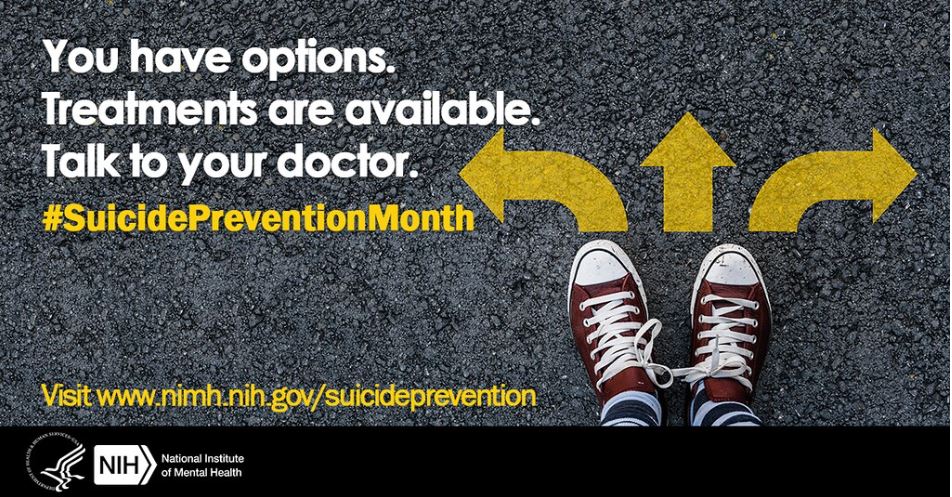
Suicide Prevention Month” by National Institutes of Health (NIH) is marked with Public Domain Mark 1.0.
“Suicide is a permanent solution to a temporary problem”
September is National Suicide Prevention Awareness Month and September 10th is National Suicide Awareness Day. During the month of September increased awareness is given to this oftentimes stigmatized and taboo topic. Suicide Prevention Awareness Month is also an opportunity to spread hope to those who have been affected by suicide as well as provide help to prevent individuals from deciding to end their life.
Suicide can impact individuals of various races, age groups or social economic backgrounds. According to the Center for Disease Control (CDC) suicide was responsible for 48,183 deaths in 2021 (which is approximately one death every 11 minutes). Additionally, the number of people who thought about suicide during this same year was an estimated 12.3 million American adults. Suicide was also among the top 9 leading causes of death for people ages 10-64 and the second leading cause of death for people ages 10-14 and 20-34. Despite these alarming statistics, in many cases, suicide can be prevented by recognizing suicide warning signs and staging an intervention before a person chooses death. https://www.cdc.gov/suicide/suicide-data-statistics.html
“Suicide Prevention Display – U.S. Army Garrison Humphreys, South Korea – 15 January 2013” by USAG-Humphreys is licensed under CC BY 2.0.
SUICIDAL BEHAVIORS/WARNING SIGNS:
“To anyone out there who’s hurting — it’s not a sign of weakness to ask for help. It’s a sign of strength.”
— Barack Obama
Many people were shock to learn about the death of Celebrity Chef Anthony Bourdain’s by suicide in June of 2018. Shortly after his death, there were various speculations as to what factors may have contributed to his decision to end his life. These speculations range from drug & alcohol use, love addiction and depression.
Anthony Bourdain is not the only celebrate who chose suicide. Other famous people include: Kate Spade (Fashion Designer), Robin Williams (Actor) and Avicii (Swedish DJ/Music Producer). There are also many other celebrities who have either attempted or contemplated suicide like: Halle Berry, Lady Gaga, Demi Lovato, Elton John, Drew Barrymore, and Elizabeth Taylor. Although suicide is not predictable, in many ways it can be preventable.
Increased risky behaviors (such as driving extremely fast)
Increased mood swings
Unexpectedly making a will
Extreme changes in eating and sleeping habits (eating or sleeping more or less)
Increased use of drugs and alcohol
Although there are many suicidal warning signs, suicide without warning is also common. According to Dr. Michael Miller (as assistant professor of psychiatry at Harvard Medical School), the people who are most intent on committing suicide know that they have to keep their plans to themselves if they want to carry out their plans, which then makes these kinds of people the most in need of help and the toughest to save.
“Many people never let on what they are feeling or planning. The paradox is that the people who are most intent on committing suicide know that they have to keep their plans to themselves if they are to carry out the act,” says Dr. Miller. “Thus, the people most in need of help may be the toughest to save.”
“Suicide Prevention” by iPredator is marked with CC0 1.0. Talk To the Discouraged
MYTHS ABOUT SUICIDE
Sometimes people who commit suicide are branded as being selfish or attention-seeking. Unfortunately, these myths and misconceptions about suicide may prevent people from being able to receive the help that they need. One of the best things that we can collectively do to support suicide prevention is being more compassionate towards others who are dealing with various mental and emotional challenges in their lives as well has educate ourselves about the myths and misconceptions related to suicide. According to the https://www.mayoclinichealthsystem.org/hometown-health/speaking-of-health/8-common-myths-about-suicide, there are several common myths about suicide:
Myth 1: Talking about suicide increases the chance a person will act on it.
Fact: Having dialogue my help a person to find an alternative view of their existing circumstances.
Myth 2: People who talk about suicide are just seeking attention.
Fact: People who die from suicide have often shared their desire to no longer wanting to live with others.
Myth 3: Suicide can’t be prevented.
Fact: Suicide is unpredictable but in many cases preventable if those contemplating suicide get support for their feelings of hopelessness, mental health illness and substance abuse.
Myth 4: People who take their own lives are selfish, cowards or weak.
Fact: The reasons behind suicide are quite complex. However, suicide is often associated with psychiatric illnesses, such as depression, anxiety, bipolar disorder, schizophrenia and substance use.
Myth 5: Teenagers and college students are the most at risk for suicide.
Fact: Although suicide is a problem among all ages and groups, the age group with the highest suicide rate in the U.S is men and women between 45 and 64.
Myth 6: Barriers to bridges, safe firearm storage and other actions to reduce access to lethal methods of suicide don’t work.
Fact: Many suicide attempts are the result of impulsive decisions, therefore limiting access to lethal means, such as firearms, is one of the simplest strategies to decrease the chances of suicide.
Myth 7: Suicide always occurs without warning.
Fact: Although suicide is unpredictable, there are oftentimes many warning signs that are given such as a person withdrawing from social contact, increased mood swings and increased use of alcohol or drugs.
Myth 8: Talk therapy and medications don’t work.
Fact: Treatment can and does work, however, finding the right kind of treatment can take time.
If you suspect that a person is contemplating suicide, encourage the person to call a suicide hotline number. In the U.S., call the 988 Suicide and Crisis Lifeline at 988 or chat at 988lifeline.org to reach a trained counselor. Call 988 and press “1” to reach the Veterans Crisis Line.
“No matter what happens, or how bad it seems today, life does go on, and it will be better tomorrow.”
“The Earth is what we all have in common”…. Wendell Berry
Earth Day has been observed on April 22nd in the United States for more than half a century and has expanded globally to nearly 200 countries. The purpose of Earth Day is to raise awareness about environmental issues. Many people also celebrate “Earth Week” which is an unofficial extension of Earth Day. The purpose of Earth Week is to draw more attention to the Earth Day Campaign.
For nearly two decades, there have been various themes associated with Earth Day. The 2023 is a continuation of the 2022’s theme of “Investing In Our Planet”.
It has been said that, “If we intend to provide a better life, and a better world, for future generations, we can’t ignore the quality of the environment we leave them“….John Kasich.
Making investments are an important part of our lives, whether that means making an investment in our environments, in our relationships, or ourselves.
“Denis Hayes, Coordinator of the First Earth Day (1970) Founder of the Earth Day Network President and Chief Executive Officer, Bullitt Foundation” by umseas is licensed under CC BY 2.0.
Q1 – HOW DID EARTH DAY BEGIN?
In 1969,San Francisco, peace activist John McConnell proposed a day to honor the Earth and the concept of peace at the United Nations Educational, Scientific and Cultural Organization Conference in San Francisco. This day was fist observed on march 21, 1970 (the first day of spring). However, Senator Gaylor Nelson, proposed a “national teach-in on the environment” which was held on April 22nd and called, Earth Day. Denis Hayes, was the coordinator of the First Earth Day and also the founder of the Earth Day Network which has expanded to many other countries.
“Earth Day – Enact 1970” by University of Michigan School for Environment and Sustainability from Ann Arbor is licensed under CC BY 2.0.
Q2 – WHERE WERE THE FIRST EARTH DAY EVENTS HELD?
The first Earth Day was held on April 22, 1970, with rallies being held in New York, California, Michigan and many other American cities.
“Conserve our beautiful earth – Melbourne World Environment Day 2011” by John Englart (Takver) is licensed under CC BY-SA 2.0.
Q4 – WHAT OTHER COUNTRIES CELEBRATE EARTH DAY?
The Earth Day Network focuses on broadening and diversifying the environmental movement worldwide and protecting the Earth for future generations. As of 2023, their efforts have led to more than 17,000 partners and organizations in nearly 200 countries with more than 1 billion people being involved in Earth Day activities, making it “the largest secular civic event in the world.”
Recycle – Free Image By Pixabay no attribution required
Q5 – WHAT ARE SIMPLE THINGS WE CAN DO TO PROTECT THE EARTH
Recycle
Conserve Water
Plant trees
Walk, bike or take public transportation
Live close to where you work
Carpool
Walk your kids to school
Put solar panels on your roof
Compost food scraps for use in your yard
Upgrade your home to current or better building standards to achieve maximum energy efficiency
Educate yourself about environmental problems and work on being a part of the solution
“7 segment self made love” by the_progressive is licensed under CC BY-SA 2.0.
Valentine’s day is widely known as a collective day to express extra love and affection to our loved ones. However, there are some who believe that you don’t need a specific day to do this. In fact, no matter how many flowers, candy or gifts you may give to your loved ones, it doesn’t mean your relationship is healthy and neither does it mean that it will flourish.
Despite the star-crossed lovers who cling for opportunities to express their affection on Valentine’s Day, there are those who have absolutely no interest in being struck or grazed by Cupid’s arrow (opting for solitude instead). According to an article posted on www.census.gov in September of 2022, nearly 50% of U.S. adults are single. Additionally, 35%-50% first time marriages in the United States will end in divorce. Of the many reasons people have given for divorcing is “Losing themselves in a marriage”.
Eckhart Tolle said it best: “When you lose touch with yourself, you lose yourself in the world.” Many mental health coaches and relationship experts will agree that one of the best ways to not lose touch with oneself is by practicing self-love.
It’s also a known fact that hurt people hurt other people which therefore supports the need and importance of learning to love ourselves first so that we can become the best version of ourselves in order to more effectively love others.
SIGNS THAT YOU ARE LACKING SELF LOVE
“self care” by Leonard J Matthews is licensed under CC BY-ND 2.0.
“The right mental attitude will guide you towards feeling a sense of love that you deserve to experience.” – Anonymous
Lucille Balle is one of the most successful actress, comedian and producers of all time. She was active in the entertainment industry from 1929 until 1989. In addition to entertaining audiences for decades, she also left her fans with many words of wisdom including these…..“Love yourself first and everything else falls into line. You really have to love yourself to get anything done in this world”.
Self love is about taking actions to support your physical, psychological and spiritual growth. However, you must first acknowledge that you are lacking self-love.
CONSTANT NEED FOR EXCESSIVE AFFIRMATIONS AND ATTENTION
Validation is a common need that we all may seek or experience at some point in our lives. Sometimes we seek validations because we didn’t receive enough of it during our childhood. Other times we seek validations to help encourage us to keep moving forward towards a goal. But the need for excessive validation and attention becomes dangerous when we struggle with making decisions on our own, fabricating or exaggerating life circumstances to gain attention from others or by becoming so emotionally distraught That we are no longer the center of attention. And part of the self-love approach to healing is to surround yourself with strong supportive individuals, being okay with saying, “NO” and practice mindful meditation.
LACK OF ASSERTIVENESS
Being assertive helps you to obtain more of what you want out of life and in your relationships. It also helps to reduce your stress levels and ensures that your needs are being met. If you don’t practice the art of communicating assertively, then you will eventually become passive which then could lead to aggressive defensive behavior.
CAMOUFLAGING OR SUPPRESSING YOUR EMOTIONS
It is a common belief that with vulnerability comes the possibility of rejection or failure, therefore many of us may feel as if we are placing ourselves in a compromising position by allowing ourselves to be vulnerable around others. Although there are times when suppressing one’s emotions may be necessary, excessive suppression can interfere with conflict resolution.
FEELING INFERIOR TO OTHERS
In psychology, an inferiority complex is defined as an intense personal feeling of inadequacy, often resulting in the belief that one is in some way deficient, or inferior, to others. However, a key part to combating this feeling is by surrounding yourself with positive people, creating positive affirmations, and exercising self-compassion.
SETTLING FOR LESS
One of the main reasons why people settle for less in life is due to having low self-esteem. Another reason we settle for less is because it has become comfortable to remain in our current situation. However, one of the best things that you can do for yourself is to accept that being single is normal and okay.
WAYS TO PRACTICE SELF LOVE
“Baby Self Love” by desertdutchman is licensed under CC BY 2.0.
“You yourself, as much as anybody in the entire universe, deserve your love and affection.” —Buddha
Self love is about taking actions to support your physical, psychological and spiritual growth which can be done in many different ways:
(1) Practicing Daily Gratitude
(2) Let Go of Toxic Relationships
(3) Embrace Your Uniqueness
(4) Forgive Yourself
(5) Continuously invest in self-care
(6) Being Okay With Say “No”
“To love oneself is the beginning of a life-long romance.” ―Oscar Wilde